

There’s a lot of alarm right now about what Mamdani’s proposed budget does to New York City’s reserves. The Rainy Day Fund gets chopped in half. The General Reserve is slashed to $100 million, the statutory minimum1 last seen in the months after COVID and 9/11. The Capital Stabilization Reserve is wiped out completely. Even the Retiree Health Benefits Trust is taking a hit. Both the Comptroller and the Independent Budget Office have raised serious concerns.
But the conversation is missing something. Most of the reserve drawdown that people are reacting to in the proposed FY20272 budget didn't happen when that budget was written. It happened earlier in a category that most people don't think of as a reserve at all.
The Budget Stabilization Account is a reserve
New York City’s fiscal cushion has several components. The ones that get the most attention are the named reserves: the Revenue Stabilization Fund (the Rainy Day Fund), the Retiree Health Benefits Trust3, the General Reserve, and the Capital Stabilization Reserve. These are explicit, they show up in reserve tables, and they’re what fiscal monitors most often point to when they talk about the city’s buffer against a downturn.
But there’s another component that functions exactly like a reserve even though it isn’t called one: the Budget Stabilization Account, usually referred to as “the roll” or the BSA.
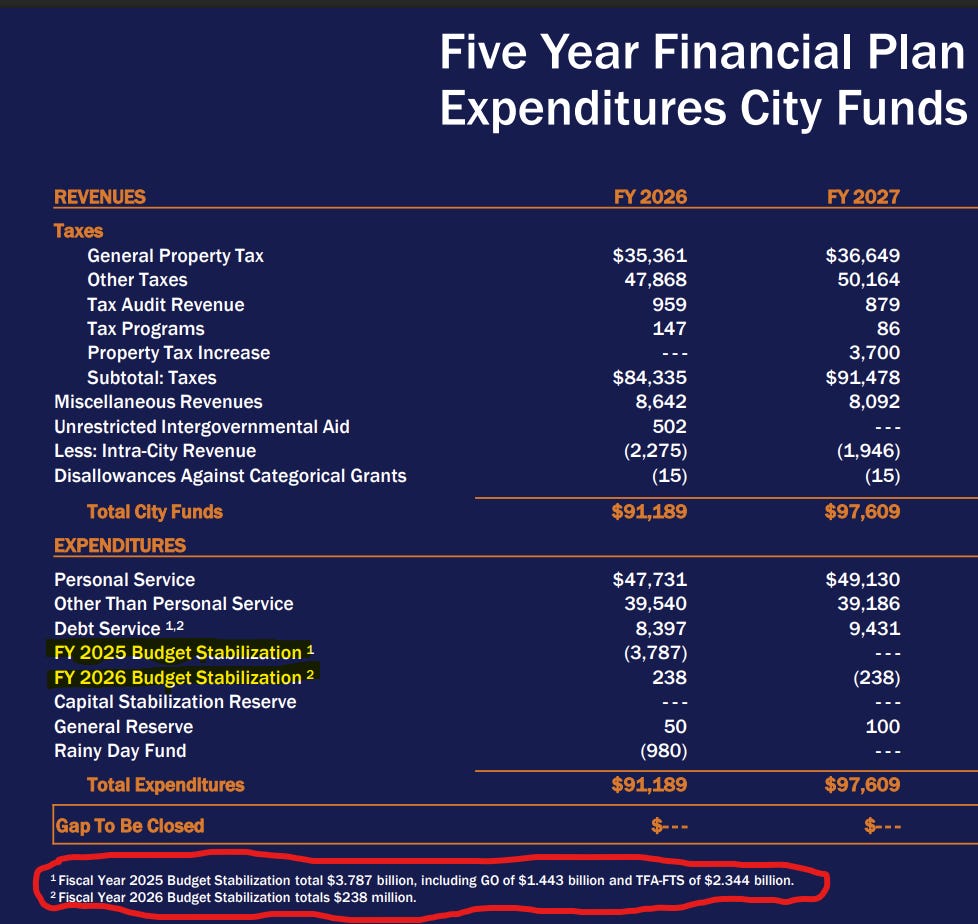
Here’s how it works. New York City is legally required to balance its budget every year. One of the main tools for doing that is prepaying next year’s expenses, primarily debt service4, with this year’s surplus. At the end of a fiscal year, whatever operating surplus the city has generated gets rolled forward as a prepayment into the following year’s budget, helping to balance the books before that year even starts.
The 2022 Comptroller’s report Preparing for the Next Fiscal Storm was explicit about this. It included the BSA in its table of the city’s total fiscal cushion, alongside the named reserves. And for good reason: a large BSA roll means the city enters the new year with a meaningful head start. A small roll means it doesn’t. Functionally, the BSA is a reserve. It just isn’t labeled one.
What the numbers actually show
Extending the analysis from the 2022 Comptroller report we can look at the budgeted and realized reserves from the past 20 years. While that report looks at prospective reserves in the Adopted Budgets, I’ve extended it to include the realized reserves reflected in the Modified Budgets.
The key differences between budgeted and realized are
the surplus rolled forward to the next year in the BSA
the amount used of general and capital stabilization reserves
Keep in mind the FY26 budget was adopted last year, so changes discussed now are mainly to reflect the actual revenues and expenses that were realized since July 1st 2025.
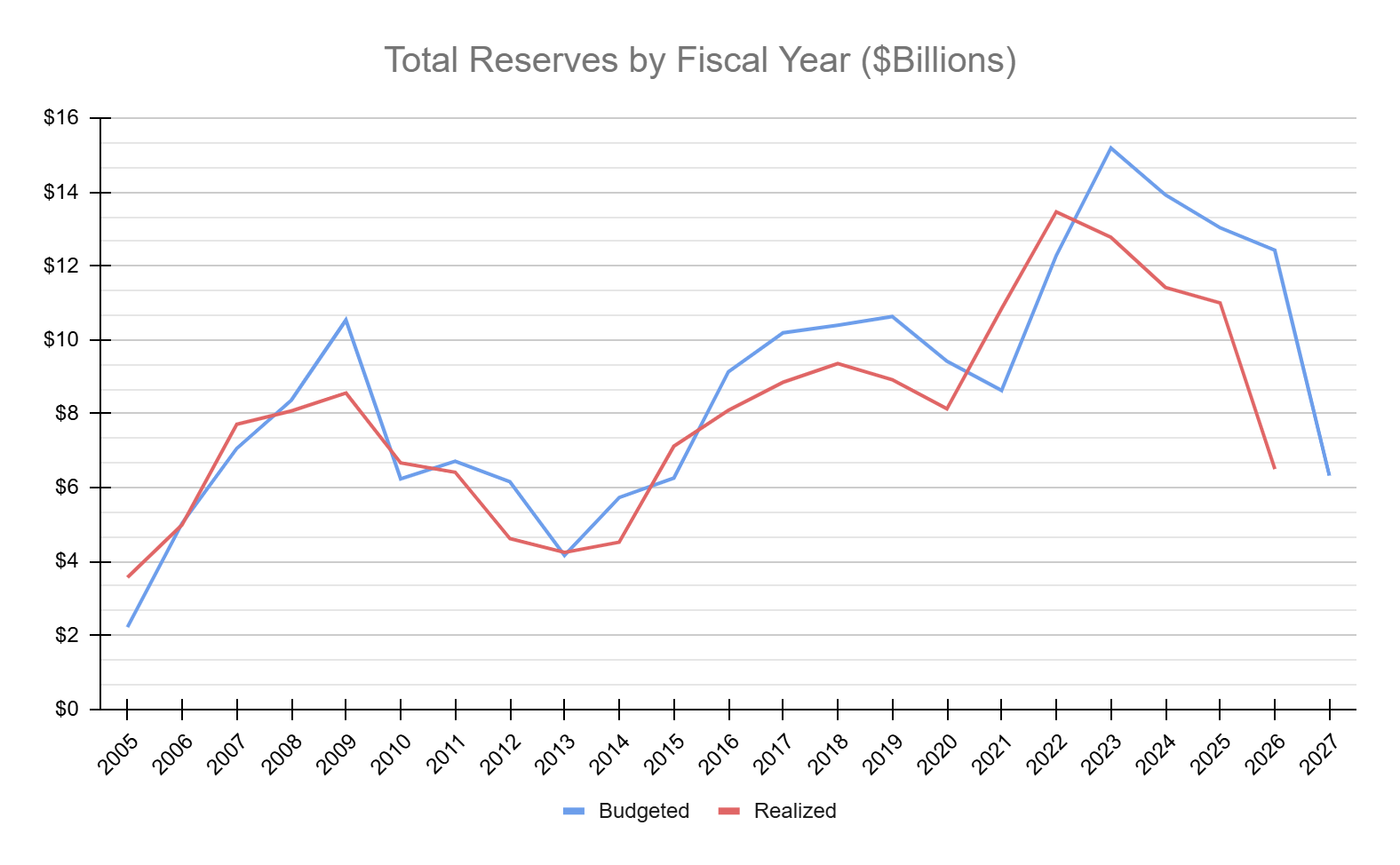
A few takeaways from this graph
Realized reserves peaked at $13.5bln under the FY2022 budget, the last under Bill de Blasio’s mayoralty, capping an $8.9bln increase over the 8 budgets during his tenure
Realized reserves started falling in FY2023, the first budget under Adams, and have dropped to $6.5bln, a $7bln decrease over the budgets during his tenure
The reasons to look at the realized reserves instead of the budgeted reserves are
Removes the impact of the Adopted budgets over- or under-estimating5 the revenues and expenditures
Includes the roll-forward of surpluses via the BSA
Reflects the long-standing practice to spend down in-year reserves (General and Capital Stabilization) to near 0
We can further break-down the realized reserves to see which funds have been tapped for that $7bln decrease
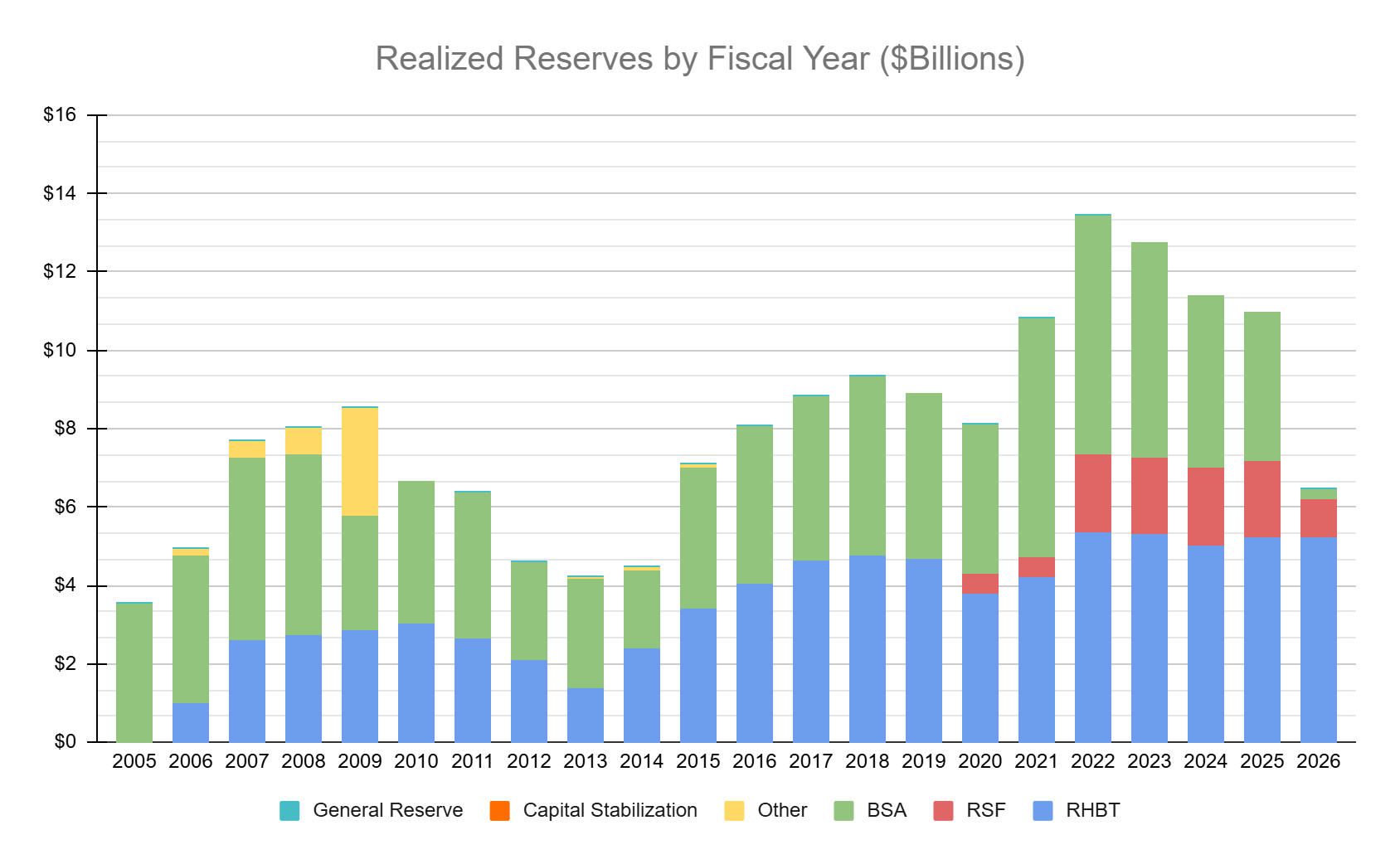
It’s not difficult to see where the changes have come from: reductions in amounts rolled forward in the Budget Stabilization Account and, for FY2026, a drawdown of the RSF in order to balance the realized budget.
The reasons for the collapse in reserves are beyond the scope of this, but it’s easy to tell a story about “underbudgeting of key services like shelter, special education, rental assistance, and overtime.” The Comptroller did exactly that in August 2025 when they warned of a $4.2bln gap in the FY26 budget. That gap is what is now being covered by the $3.5bln drop in the BSA roll and a $980mln draw from the Rainy Day Fund.
Looking forward to FY2027
We are where we are and there’s no use in blaming the authors of the current budget for a years long practice of drawing down the City’s reserves.
Switching our view from realized to budgeted reserves, including this year’s proposed budget, we see:
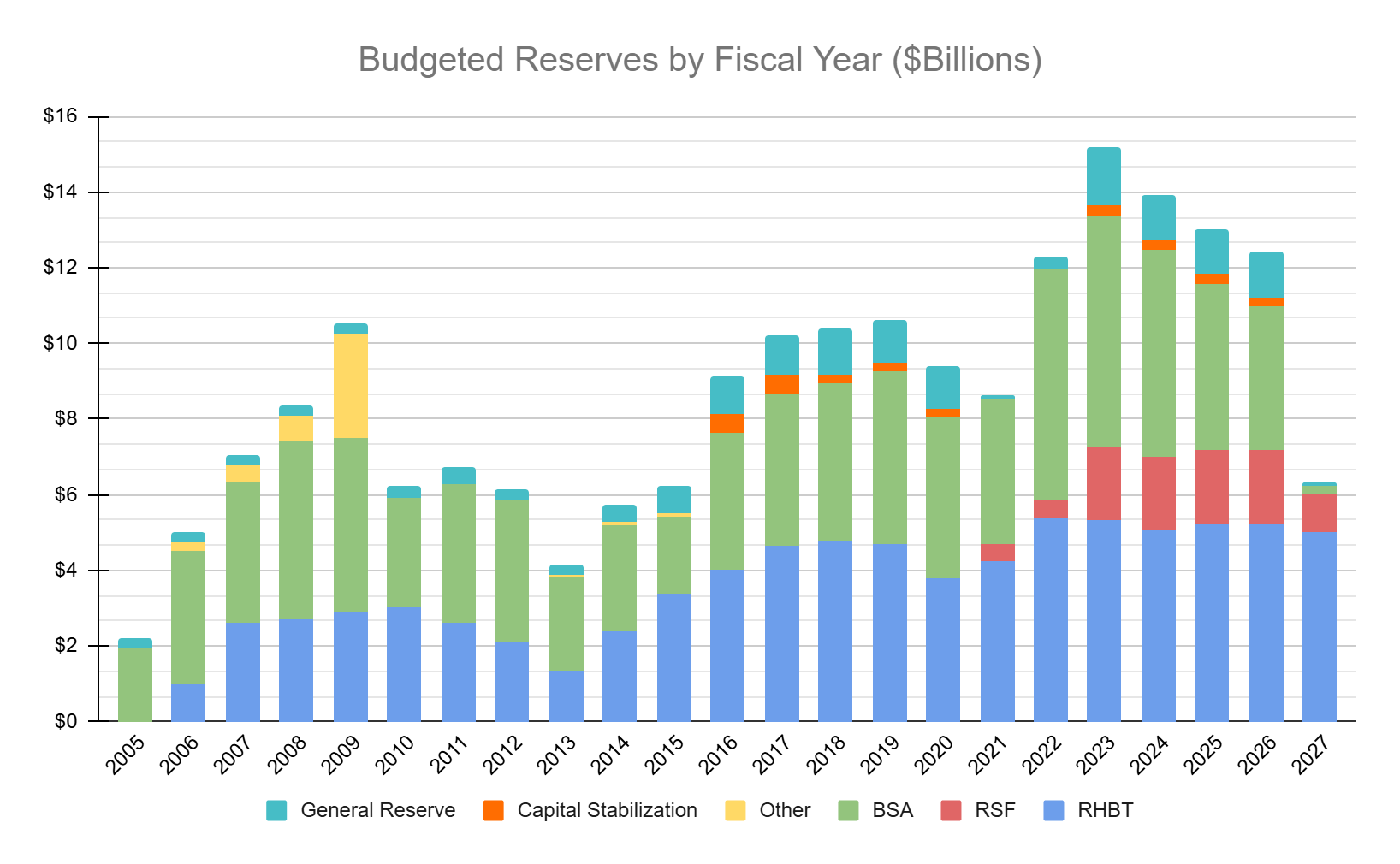
Some things to note here
The BSA drops off simply because we’ve already used it all, there’s essentially no surplus to roll forward
The General and Capital reserves start at only $100 million. That leaves little room for the now typical overages
The RHBT is reduced by $229 million. That level of fluctuation is not unusual, but seeing it baked into the proposed budget is
The preliminary budget hearings have only just begun, so we’re likely to hear much more about this in the coming months before the budget is finalized.
The alarm may be warranted. It's just about four budgets late.
Data Addendum
A combination of sources was used for compiling the reserves, primarily
The 2022 Comptroller report Preparing for the Next Fiscal Storm
Office of the Actuary Valuation Reports on the RHBT, to separate the RHBT+RSF data in the above report
The Comptroller ACFRs for more recent years
The Financial Plans in the OMB budgets
The RHBT and BSA also aren’t traditionally budgeted in the same way as other reserves. I held the budgeted vs actual RHBT as the same each year and used the prior year’s actual BSA to say what the current year’s budgeted BSA is, essentially saying they hold the roll constant. For transparency, here are the actual numbers I used.
Budgeted Reserve Figures
FY,RHBT,RSF,BSA,Other,Capital Stabilization,General Reserve,Total Budgeted,Change
2003,0,0,,0,0,200,200,
2004,0,0,1417,0,0,300,1717,
2005,0,0,1923,0,0,300,2223,506
2006,1001,0,3529,200,0,300,5030,2807
2007,2594,0,3751,414,0,300,7059,2029
2008,2726,0,4665,675,0,300,8366,1307
2009,2878,0,4635,2726,0,300,10539,2173
2010,3023,0,2914,0,0,300,6237,-4302
2011,2632,0,3646,0,0,437,6715,478
2012,2116,0,3742,0,0,300,6158,-557
2013,1363,0,2462,38,0,300,4163,-1995
2014,2378,0,2807,99,0,450,5734,1571
2015,3397,0,2006,103,0,750,6256,521
2016,4036,0,3601,0,500,1000,9137,2882
2017,4654,0,4038,0,500,1000,10192,1055
2018,4766,0,4180,0,250,1200,10396,204
2019,4680,0,4576,0,250,1125,10631,235
2020,3800,0,4221,0,250,1150,9421,-1209
2021,4221,493,3819,0,0,100,8633,-789
2022,5376,499,6107,0,0,300,12282,3649
2023,5318,1954,6114,0,250,1555,15191,2909
2024,5038,1959,5479,0,250,1200,13926,-1265
2025,5225,1964,4397,0,250,1200,13036,-890
2026,5225,1969,3787,0,250,1200,12431,-605
2027,4996,989,238,0,0,100,6323,-6108
Realized Reserve Figures
FY,RHBT,RSF,BSA,Other,Capital Stabilization,General Reserve,Total Realized,Change
2003,0,0,1417,0,0,40,1457,
2004,0,0,1923,0,0,40,1963,
2005,0,0,3529,0,0,40,3569,1606
2006,1001,0,3751,200,0,40,4992,1423
2007,2594,0,4665,414,0,40,7713,2721
2008,2726,0,4635,675,0,40,8076,363
2009,2878,0,2914,2726,0,40,8558,482
2010,3023,0,3646,0,0,0,6669,-1889
2011,2632,0,3742,0,0,40,6414,-255
2012,2116,0,2462,0,0,40,4618,-1796
2013,1363,0,2807,38,0,40,4248,-370
2014,2378,0,2006,99,0,40,4523,275
2015,3397,0,3601,103,0,20,7121,2597
2016,4036,0,4038,0,0,20,8094,974
2017,4654,0,4180,0,0,20,8854,760
2018,4766,0,4576,0,0,20,9362,508
2019,4680,0,4221,0,0,20,8921,-441
2020,3800,493,3819,0,0,20,8133,-788
2021,4221,499,6107,0,0,20,10846,2713
2022,5376,1954,6114,0,0,20,13464,2618
2023,5318,1959,5479,,0,20,12776,-688
2024,5038,1964,4397,,0,20,11419,-1357
2025,5225,1969,3787,,0,20,11001,-418
2026,5225,989,238,,0,50,6502,-4499The minimum reserve was set at $100 million in 1975 as part of the City’s Fiscal Crisis. If the minimum reserve was set at a percentage of the budget instead of a fixed dollar amount, it’d be about $1 billion today.
Note on NYC Fiscal Years: they run from July 1st to June 30th, so the FY27 budget will be adopted by June 30th, 2026 to cover July 1st 2026 to June 30th 2027. The FY26 budget was adopted in 2025 and is regularly updated to reflect the actual revenues and expenditures for FY26 vs. the estimates that were in the adopted budget.
The RHBT isn’t exactly a reserve either. The funds in the Trust can only be used to pay retiree health benefits, not for general needs. However, the City can effectively use it that way by simply reducing its health benefit contributions in any given year.
This also comes up in the context of the Constitutional Tax Limit on Real Estate.
This substack gets its name from the bygone Board of Estimate of the City of New York, so named for its power to “estimate” the revenues and expenditures that make up the budget.
Interesting so basically the BSA is a reserve but isnt called that so flags werent raised even though it has been tapped in to for multiple years now?