

The DOF has indicated they’ve provided much of the relief sought by plaintiffs in the pied-a-terre tax suit, according to court filings made today. They didn’t exactly use those words, but in sum and substance it achieves most of what was sought.
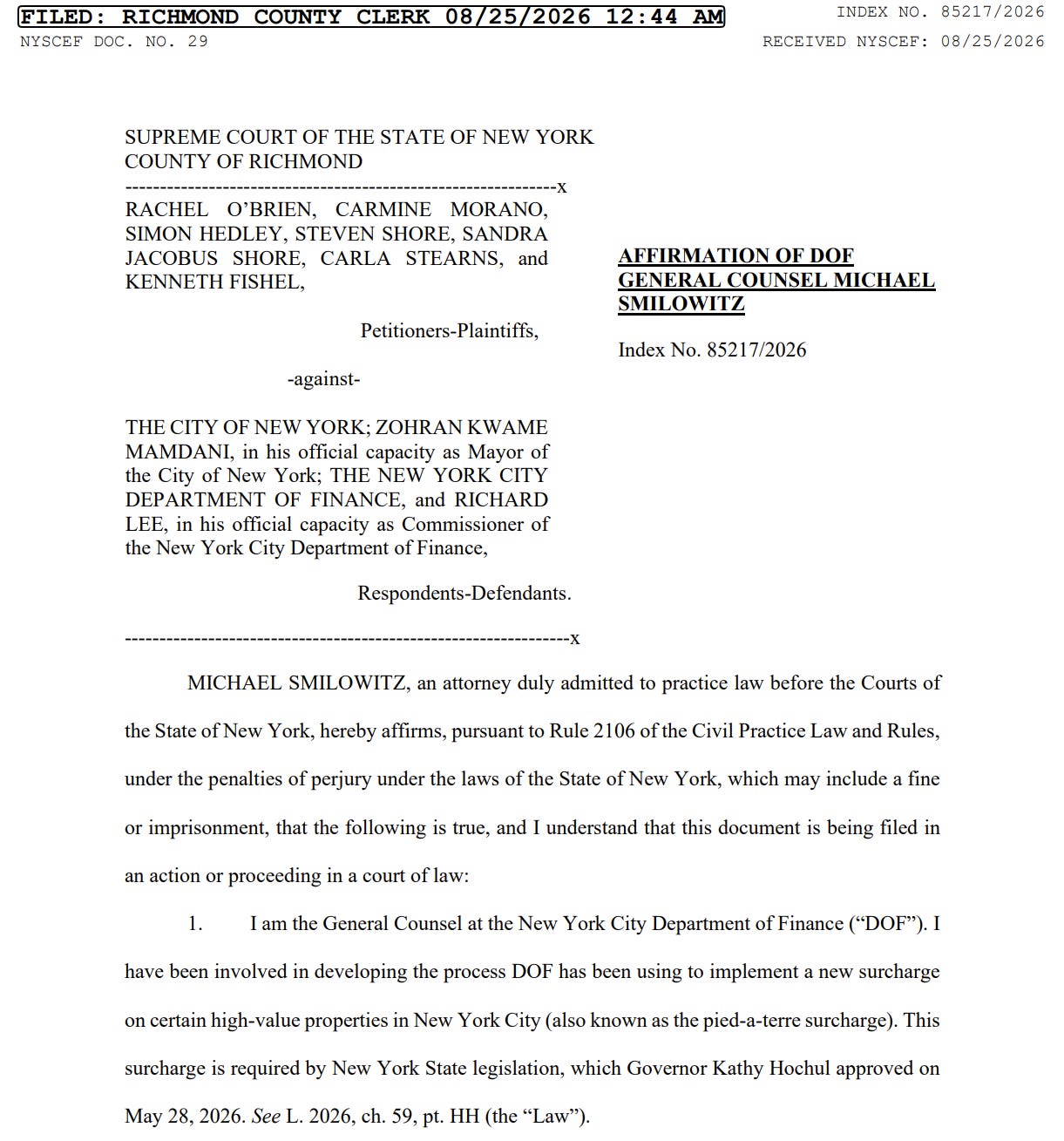
In short, the City obtained the 2025 NYS Income Tax Return data on August 12th and used it to exempt an additional 1,210 properties that were initially noticed, sparing them the burden of proving an exemption.
What the City Initially Did
In an affirmation of Michael Smilowitz, General Counsel at the DOF, he detailed the steps the City took in its initial determination of what properties may be subject to the tax. In addition to the property valuation and type, the DOF used the following data to exclude properties
Properties with an exemption that required primary residence of the owner, including
STAR (income based)
SCHE (age and income based)
DHE (disability)
Veterans
Clergy
Units that received a coop/condo abatement AND were
verified as primary residences under a recent compliance check, OR
indicated as primary residence on the owners’ 2024 NYS tax return
The DOF did NOT use 2024 state tax return data as a primary determinant of primary residency, which was available to them as of Feb 2026. It was only used in conjunction with coop/condo abatement data, which requires primary residency but is not verified as strictly as STAR, SCHE, etc… exemptions.
How the Lawsuit has Proceeded
On July 22nd, the DOF sent initial determination notices out to 17,000 property owners indicating they may be subject to the tax absent an approved exemption. This was well ahead of schedule; the notice deadline under NYS Tax Law Section 1352(2) is August 30th for this year.
On August 7th the plaintiffs commenced this lawsuit challenging the pied-a-terre tax rollout. In substance, they requested the City
stop “doxxing” owners, take down the supplemental roll of over 900,000 homes
use all information available to re-do the initial determinations, namely property tax exemptions/abatements and state tax returns
re-notice properties using the new determination
On August 10th, the judge granted temporary relief to the plaintiffs, enjoining the City’s continued publishing of the supplemental roll and the rollout of the pied-a-terre tax.
On August 12th, two more things happened. The City appealed this order and it received 2025 tax return data from the State. It is not stated when the City first requested the 2025 data from the State, other than to say it would ordinarily be received in February 2027 if not but for their expedited request.
In today’s filing on August 25th, the DOF states they’ve updated their initial determinations based on the 2025 tax return data and sent new notices to the 1,210 affected owners, excluding the 2,892 properties that applied for and were approved for exemptions. That is to say, the DOF claims to have now used all the sources of information available to it that the plaintiffs named.
There may be disagreement as to the exact methods the DOF applied to the data. Perhaps they should have taken a coop/condo abatement as primary evidence of primary residence? Or maybe they should have made more favorable inferences about properties owned by trusts? Those choices do seem to be well within the DOF’s discretion, however, and not what I’d consider arbitrary and capricious.
Additionally, the DOF sent 10,800 new notices to provide additional details as to why they weren’t automatically exempted. That is comprised of 4,400 natural persons and 6,400 artificial persons (LLCs, Trusts, and so on) where 2025 tax return data did not prove primary residency.
What Remains?
The only remaining substantive relief sought by the plaintiffs is for the DOF to take down the supplemental roll.
In the view of the plaintiffs, this may be a very significant part of the relief they seek. Practically, it is difficult to square that with its widespread distribution since publication, and the ready availability of substantially similar data elsewhere.
The only data in the supplemental roll not available in the regular roll is the imputed share ownership of coop units. It’s hard to imagine anyone getting too upset over imputed share ownership, particularly absent a named owner, but to each their own.
Where Do We Go From Here?
The appellate court for the 2nd department has stayed the trial judge’s temporary order, pending a determination on the appeal. In the meantime, the trial judge will be holding a hearing on August 31st for providing permanent relief to the plaintiffs. If he were to rule in their favor, that would supersede the stay of the existing order.
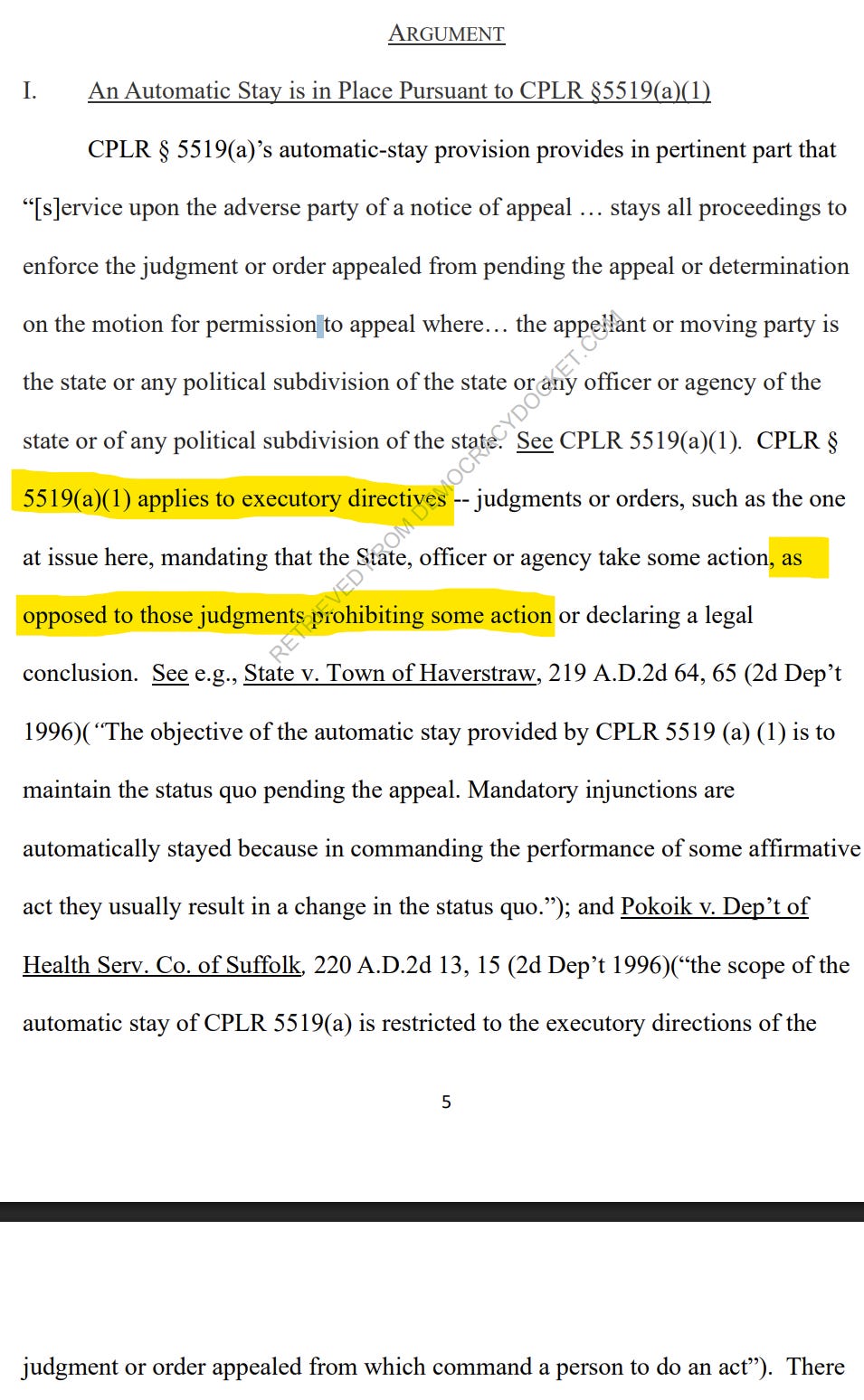
The City would likely appeal and claim an automatic stay of the new orders, as they did for the previous ones. A decision may contain executory orders (e.g. “you must take down the roll”) and prohibitory ones (e.g. “don’t proceed with the tax”). Under the City’s interpretation, CPLR 5519 entitles them to automatic stays of both kinds of orders, not merely the executory ones as plaintiffs contend.
The City’s interpretation that automatic stays apply to prohibitory orders is somewhat novel. It is based on a short April 2026 decision on a motion issued by the NY Court of Appeals

That is the entire decision. Though it is possible Court of Appeals meant this to overturn the oft-cited standards established in Pokoik v. Dep’t of Health Serv (1988) and State v. Town of Haverstraw (1996), it would be an unusual way for them to do so.
The Court of Appeals has relied on these 2nd dept appellate precedents as recently as 2023, interpreting CPLR 5519 as applying only to executory orders
A court may not need to make a decision on the application of automatic stays in resolving this case, but selfishly I hope they do.