


Update June 23rd 6:23PM: A DSS Spokesperson provided the below response
The agency strictly complies with New York State Social Services Law § 136, which legally mandates the protection of client information. This includes safeguarding the specific locations of shelters to ensure the privacy and physical safety of vulnerable New Yorkers. We do not publish these addresses as a matter of course, and any reckless publication of this data by third parties puts individuals at risk.
Author’s Note on DSS Statement: I have provided public links to shelter information for the addresses published below, most of which are public procurement contracts published in the City Record. Others come from public presentations by the DHS to Community Boards, as required by NYC Admin Code §21-324, adopted to add transparency to the siting process.
Shelters for domestic violence victims are separately protected under New York State Social Services Law § 459-h, however none of the shelters listed below are for domestic violence victims. Interpreting §136 as protecting regular shelter addresses is a broad interpretation I have not seen presented before, nor was it applied prior to late 2024 in EAS filings.
Update June 24th 5:33PM: I neglected to find NYP Holdings v NYC DSS (2025), a 1st appellate division case that squarely decides this in favor of DSS and their practice of withholding shelter addresses. More here
Homeless shelters in NYC are a controversial topic. While most agree on the moral need to provide housing, not to mention the 1981 Right to Shelter settlement, there is often local resistance to the siting of any particular shelter. In many ways it’s even more fraught than the debates over regular housing development.
The siting of shelters is subject to a “Fair Share Analysis”, introduced into the City Charter following the 1989 Charter Revision Commission’s remaking of NYC’s government. The adopted criteria are published in Appendix A, Title 62 of the Rules of the City of New York. (note the asterisk in the “rules”)
In 2023, Brad Lander as Comptroller wrote a great deal about Fair Share. In short, the Fair Share Analysis is intended to balance the siting of shelters across the City and to not concentrate them in a small number of communities. But setting that aside ….
Environmental Review of Shelter Contracts
Somewhat more obscurely, DHS grants contracts to operate shelters. That discretionary action makes them the lead agency for the City Environmental Quality Review (CEQR) pertaining to shelters.
As lead agency, they are responsible for producing an Environmental Assessment Statement (EAS) and determining if there is a significant adverse effect on the environment. A “Negative Decalaration” means a project can proceed
Those EAS’s are where the Department of Homeless Services unusual practice of redacting location information comes up.
As early as November 2024, and continuing through June 2026, DHS has redacted addresses from their mandated and publicly available environmental assessments. They went from looking like this
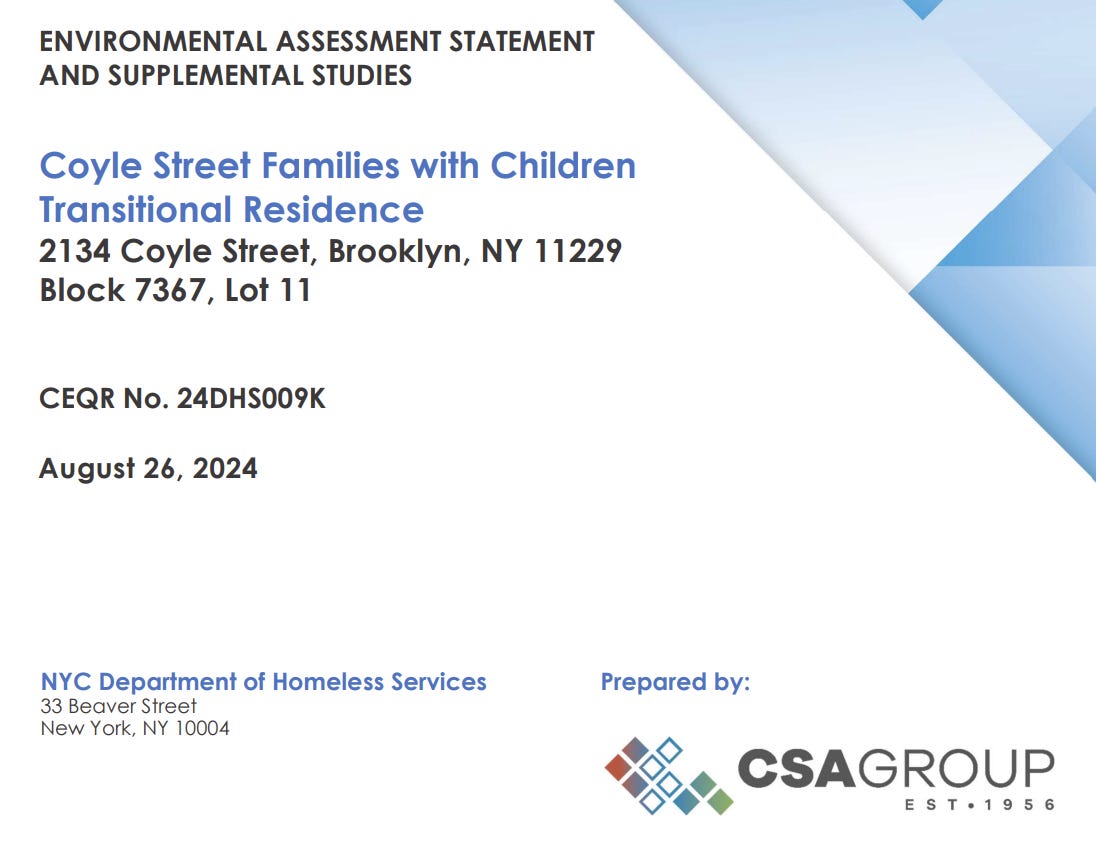
To looking like this:
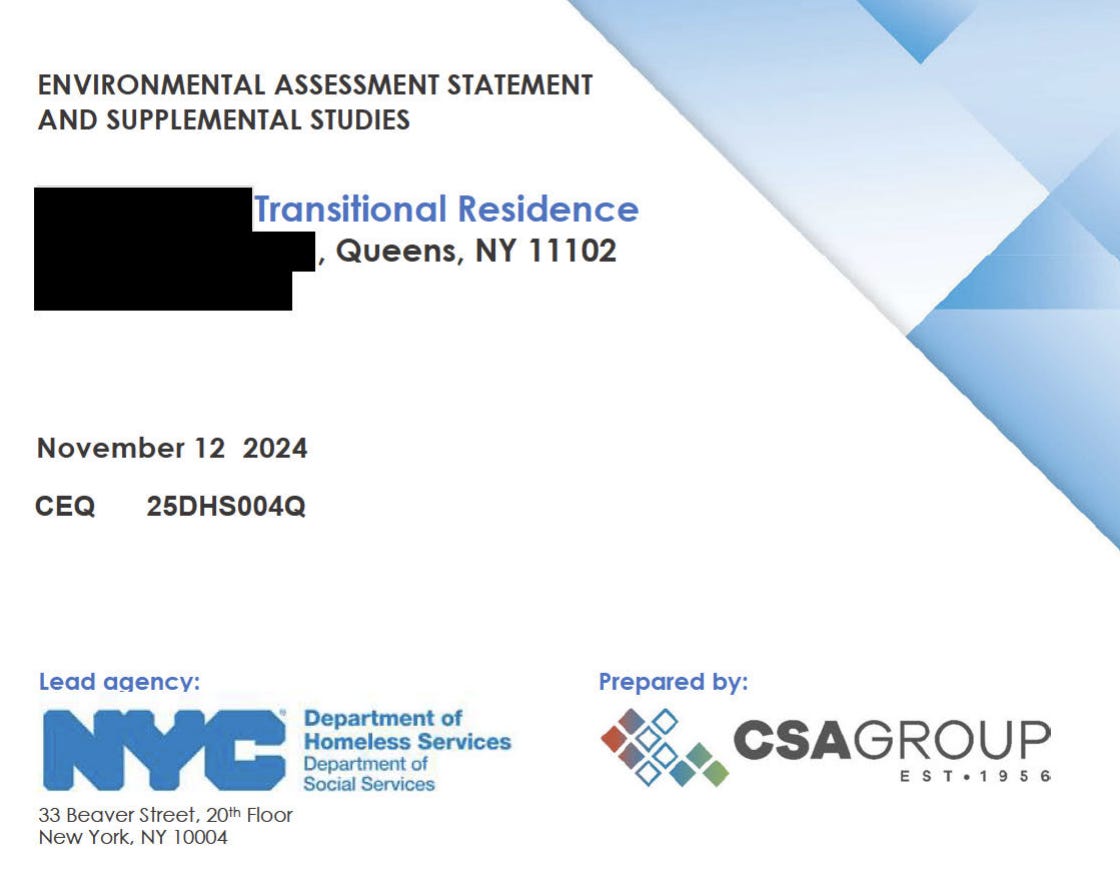
It is unclear why DHS began this practice or their legal basis for redacting locations. However they have consistently redacted every EAS I’ve reviewed since mid-2025 and continuing through the most recent June 2026 filings
The Article 78 Wrench
This is notable because DHS’s negative determinations of environmental impact are subject to legal challenge under Article 78 of the NYS CPLR (a popular vehicle for challenging government actions).
BUT there is a strict 120 day statute of limitations on these challenges. Once the DHS has made its “Negative Declaration”, affected parties have just 120 days to challenge it.
The obvious problem: how would a party know they’re affected by an environmental review if they don’t know the location that was reviewed?
This isn’t purely academic and has come up in at least two recent lawsuits over DHS shelters.
Lenox Hill Shelter
In a challenge to the Lenox Hill shelter at 1114 First Avenue, the petitioners’ Article 78 CEQR challenges were dismissed for failing to file within the 120 day statute of limitations.
The DHS made their final determination in July 2025 and the suit was filed in March 2026. Pretty straightforward. Except the petitioners had no reasonable way of knowing that DHS’s determination was for a neighboring building because this is what the determination looks like:
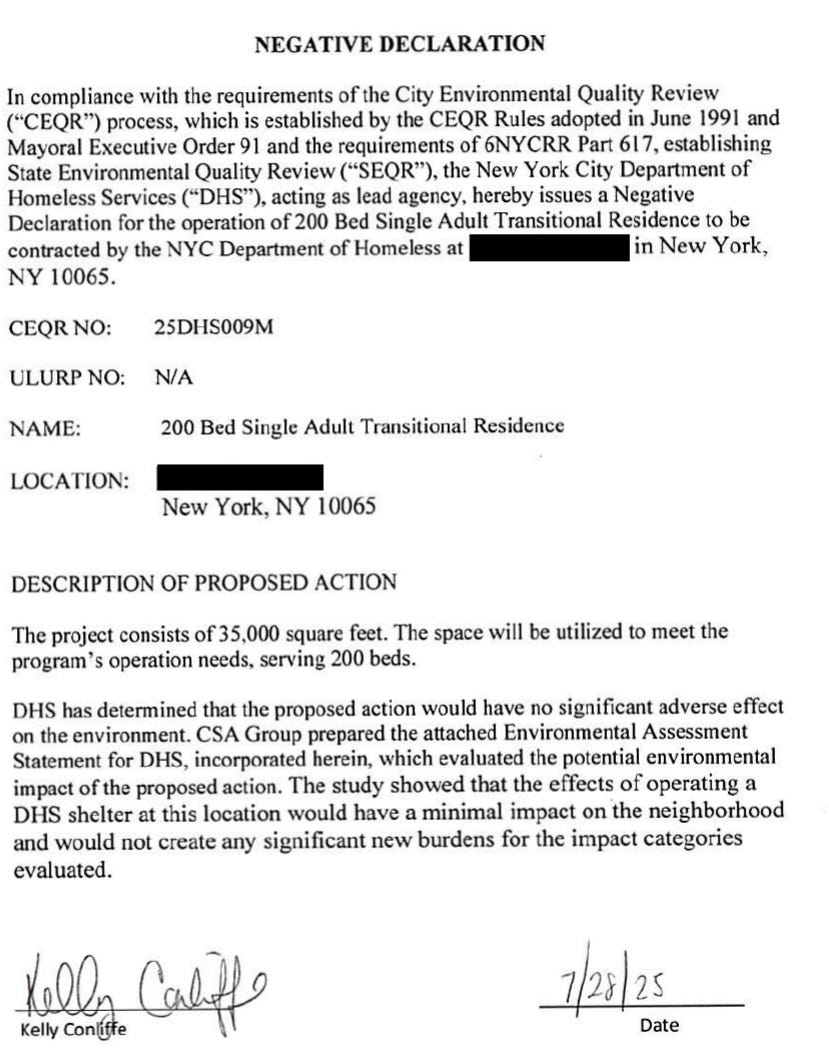
The petitioners claimed they only received constructive notice of the shelter in February 2026, more than two months after the deadline to file a challenge to the CEQR determination. Nevertheless, that claim was dismissed.
Greenwood Heights Shelter
In another case, Greenwood Heights resident Hokan Topal is challenging the siting of a shelter at 225 25th Street.
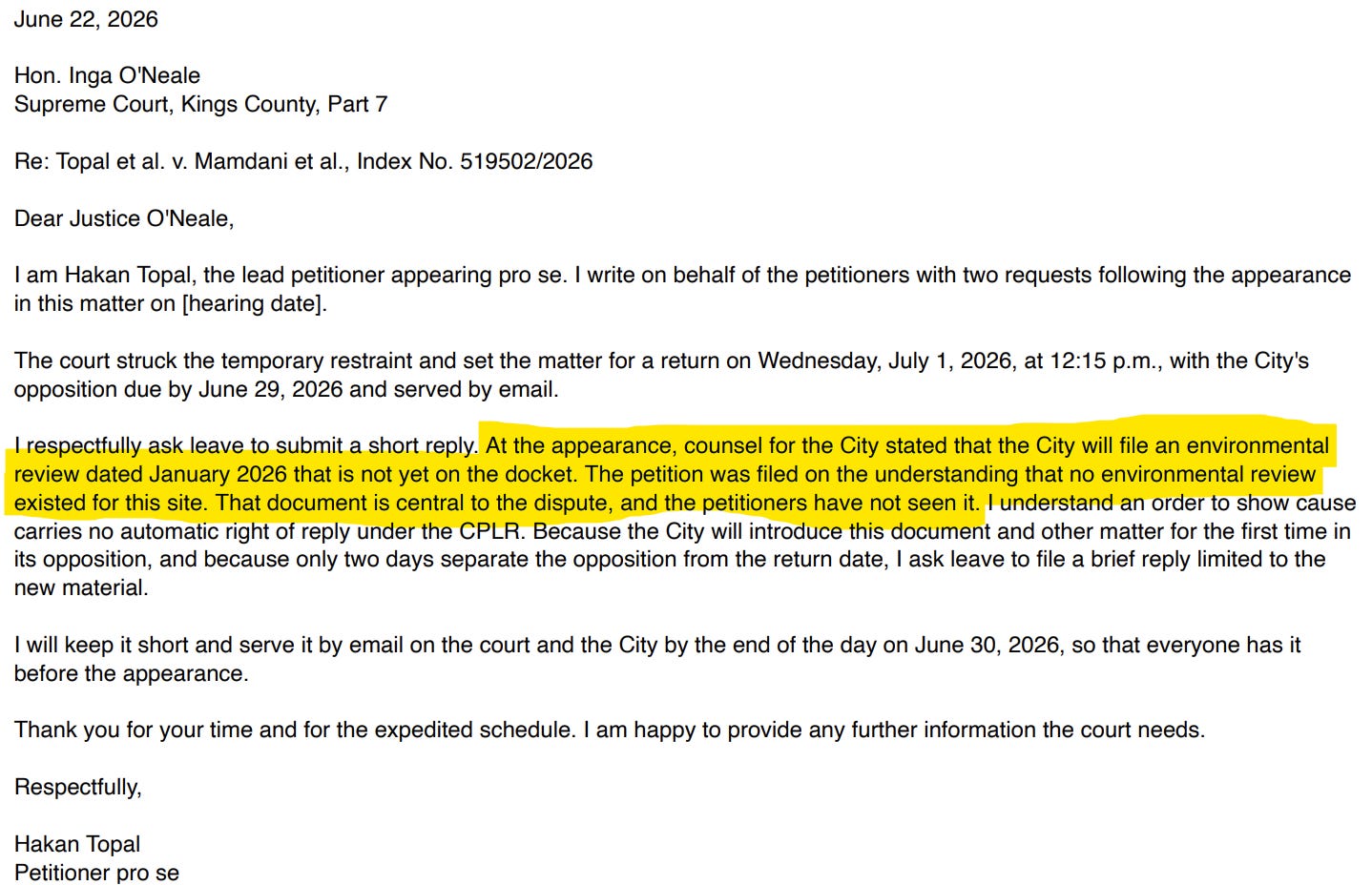
The petition includes both Fair Share Analysis and CEQR claims, with the May 2026 filing noting that no CEQR review had been performed at all:
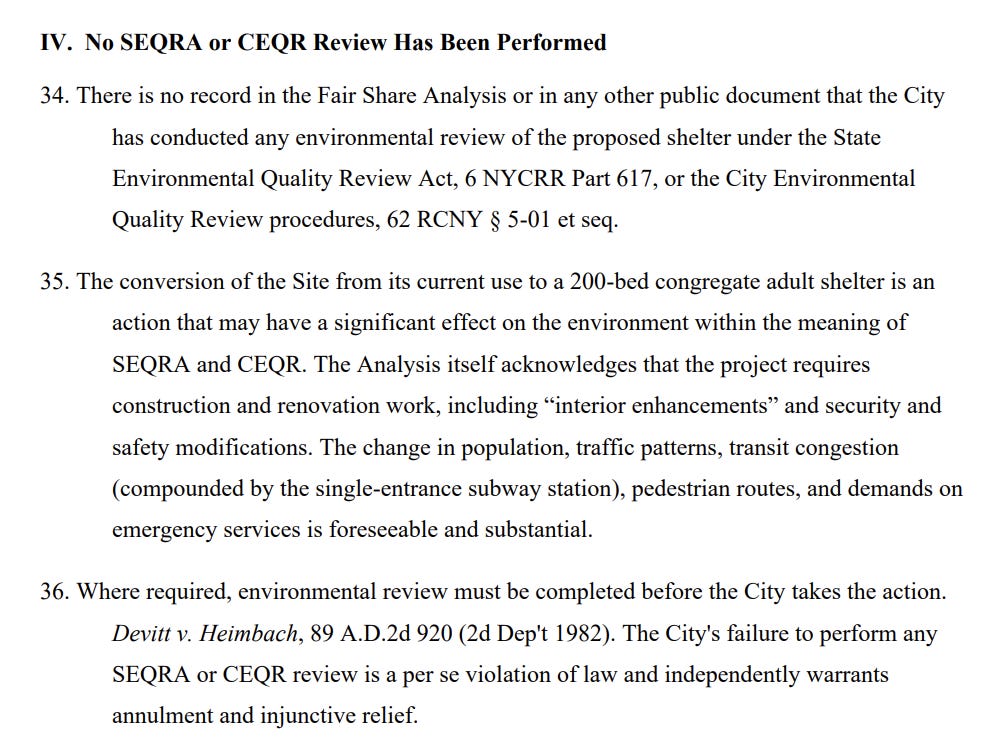
This, it turns out, is not quite true.
In fact DHS did file a review in January 2026, making their determination of no impact on January 20th. Topal would have had no way of knowing this though since the location is fully redacted
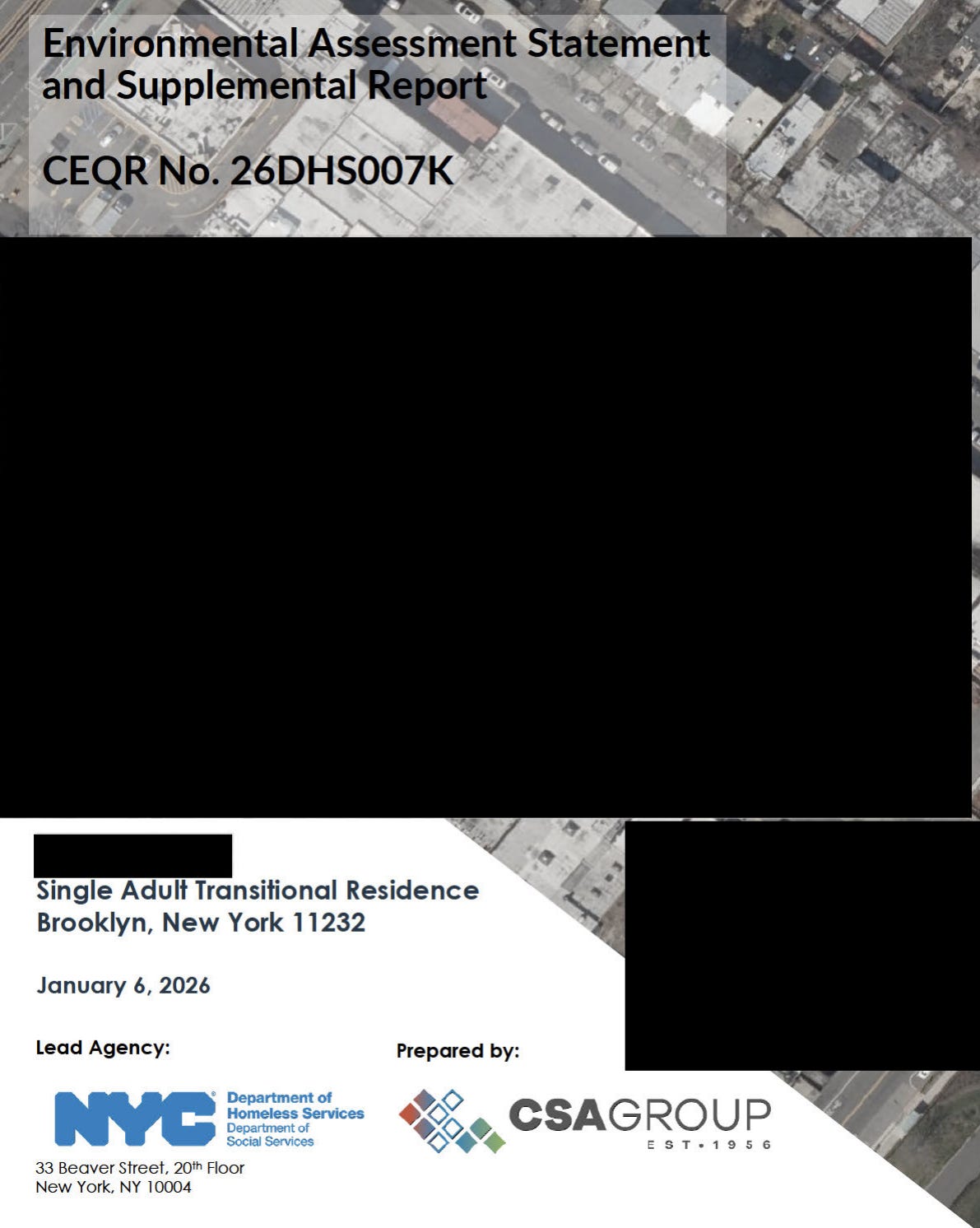
Unfortunately for Topal, his May 22nd petition was filed 122 days after the final agency determination, seemingly just outside the window for an article 78 challenge. Perhaps there’s a little wiggle room there though?
Other Thoughts
More generally, the redaction of location information from environmental assessments cuts against the transparency that environmental reviews are intended to provide. DHS may have valid, persuasive reasons why this practice is both legally and normatively acceptable. I have requested comment from both DHS and the Mayor’s Office of Environmental Coordination for comment and will update this post with any responses.
I’ll also note that even though DHS has begun redacting shelter locations from EAS filings, they are largely a matter of public record from other sources. The locations for specific CEQRs can also be inferred with a high degree of confidence by cross-referencing the filings with other public City data.
For the convenience of others, I’ve located the redacted addresses of the 18 shelter related EASs that DHS has filed since late 2024. I’m comfortable sharing this since none of these locations is a secret and can be readily discovered via Google, which makes it all the more baffling that DHS redacts them in their CEQR reviews.