

In recent days, the Mayor’s Office has circulated a plan to increase tax revenues through a combination of Income, Corporate, Property, Sales and Transfer taxes.
This post is about the “Property tax surcharge on high value homes” and the implementation challenges it would face.
tl;dr - The proposal inadvertently taxes all co-op buildings valued over $5 million, representing over 80% of co-op apartments. Condos/co-ops are also systematically undervalued, exposing how the city's valuation system makes this kind of proposal extremely difficult to implement fairly
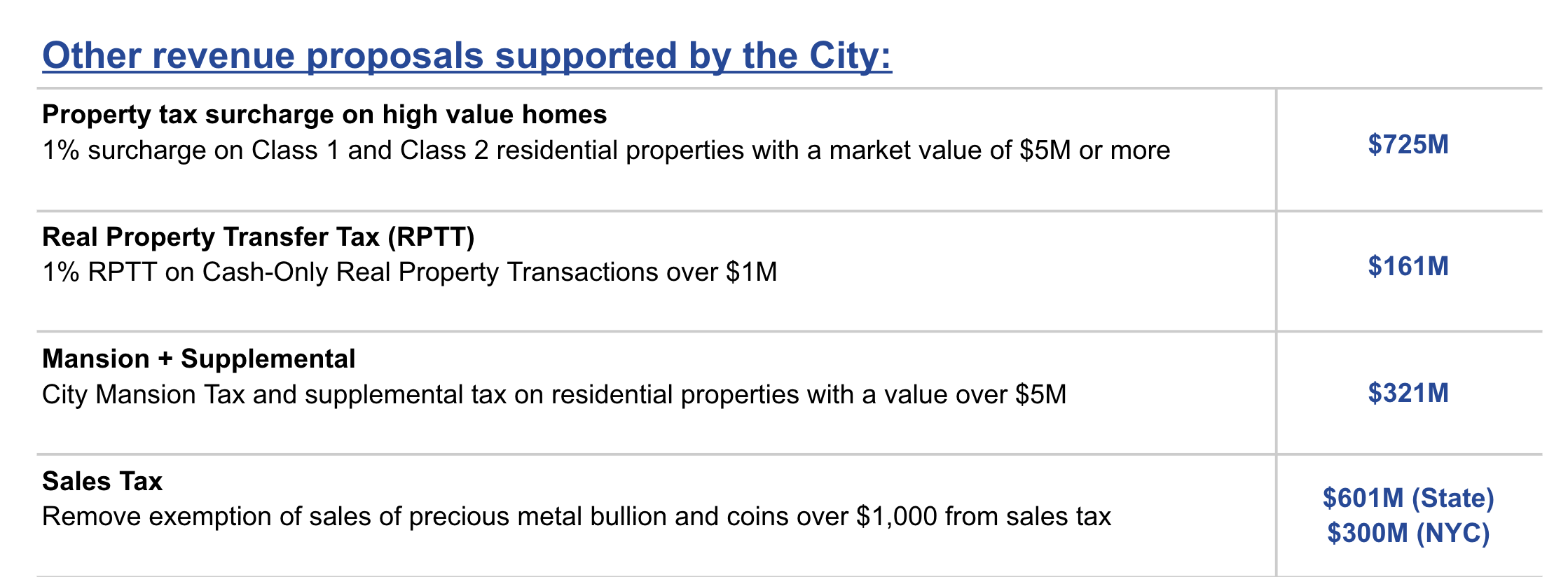
The circulated proposal is rather bare bones, so we’ll have to fill in a few of the details on how it works. If these assumptions are wrong, the analysis that follows may also be wrong.
What Is The 1% Property Tax Surcharge?
Well, we know or can reasonably assert a few things about it.
It applies to Class 1 (1-3 family homes) and Class 2 (co-op, condo, rental) residential properties
Per the article, it only applies to “homes,” meaning owner-occupied, and not rental buildings
The “market value” is the valuation produced by the Dept. of Finance for Property Tax Calculations
The $725m estimate is of annual revenue from the tax
So far so good. Some other assumptions, which require a little more of a leap, are
The 1% tax is additive to existing taxes, not a 1% relative increase to them
The 1% only applies to the market value in excess of $5m. A property’s taxes should not increase by $50,000 if it goes from a $4.999m to $5m
Easy enough. The DOF Property Valuations are readily available from Open Data and every parcel has a classification code that tells us if it’s a co-op, condo, home or rental building.
Does It Math?
Yeah, basically. Following these steps, you should be able to get similar numbers. I used FY 26 final assessment rolls but you’d get similar results with the FY 2027 tentative assessments.
Filters
Class 1 and Class 2 residential only
Building codes that correspond to 1-3 family homes (all As, Bs and C0)
Co-op apartment buildings (C6, C8, CC, D0, D4, DC and R9)
Condo units (R1 through R8)
Market Value >= $5m
Taxable (as in the exemptions are not 100% of the value)
The results looking exclusively at $5m+ homes are

Ok, so $771m total revenue. Not wildly off from their $725m estimate. I may be including some building codes that they are not and maybe they’re reserving a bit for actual collection rates. Seems like a pretty plausible number if I’ve understood their proposal correctly.
So What’s The Problem?
The issues here aren't really with the proposal's intent, but rather stem from longstanding quirks in how NYC assesses property.
Condos are only generating $3m of revenue across 144 units in 85 buildings. That’s just not very much.
Co-ops, however, generate over 70% of the revenue ($556m). Getting stranger …
The average in-scope co-op unit is $188 / square foot and valued at $222k. That’s a lot less than $5m!
The results don’t really make much sense, until you understand a couple things about DOF Property Valuations.
Condos and Co-ops are valued at a fraction of their true market value due to the DOF valuing them as though they were rentals. Mostly rent-stabilized rentals to boot
Condos are valued at the unit level. Typically the DOF values the whole building first and then allocates to units based on their square footage, but importantly each unit gets its own valuation and tax bill
Co-ops are valued and taxed at the building level. There are no unit level values. Taxes are passed-through from the building to the share-holders, but ultimately there’s just one tax bill for the whole building
Here’s the entire universe of condos/coops/homes to put this into context. Note the implausibly low values for condos and co-ops of $347 and $185 per square foot.

All this together explains why co-ops have such a large share and condos have such a low share: this tax applies to all co-op buildings over $5m but only condo units and 1-3 family homes that are over $5m. Those are very different!
Half the co-op buildings representing 80% of co-op units would be subjected to this tax. Suffice it to say, far less than 80% of co-op apartments are truly worth more than $5 million dollars.
You Obviously Did It Wrong
Well, maybe? But I don’t see another plausible reading that makes this proposal math. If you think of a better interpretation, please please please let me know and I can update this.
There are very few co-op units that DOF could plausibly value over $5m for the same reason there are so few condos over $5m: their methodology undervalues them by ~2x-4x their true market value.
A co-op or condo the city values at $5m is probably worth $10m, $20m or even more. There just aren’t that many apartments that sell for 8-figures. What’s more, the DOF has no ability to value individual co-op units. The data and methods simply aren’t there.
If the city completely overhauled its valuations of co-ops and condos, I could see this working. But that’s a big lift and probably not what the proposal contemplates.
This Is Silly, Why Would The Mayor Want To Increase Taxes On 80% Of Co-op Apartments?
I seriously doubt he does. My best guess is whoever prepared the revenue estimate was not aware of the landmines lurking in NYS Real Property Tax law. It’s easy to miss that co-ops are taxed at the building level and that both condos and co-ops are systematically undervalued.
In their defense, this is in the category of “Other revenue proposals supported by the City.” It is not in their top priorities and I think it has little chance of going anywhere.
However, it is still concerning to see such a glaring issue with one of the Mayor’s property tax proposals. The 9.5% proposed increase is also challenging and possibly capped by the Constitutional Tax Limit. These issues highlight how difficult it is to tweak the current system without a overhaul to the underlying structure.
Conclusion
Property Taxes in NYC are super complicated. I wrote 3,000 words about it and that was only scratching the surface. I didn’t even cover the unit vs building level assessments for condos and co-ops.
There are a lot of ways that our property tax system can be made more equitable and raise more money from taxing the wealthiest. Some of them can be done quickly by the City itself, but true and lasting reform may require a refactoring of the system.