

Clarification: The “phase-in” I refer to here is the ramp up of the tax rate around market value thresholds. It does NOT refer to a phase-in of the tax over time. Apologies to practioners for my non-standard use of the term, and thank you to Martha E Stark for providing this and many other helpful comments.
Update: Added the surcharges by boro, block an lot (BBL) below with some light annotations. This can be downloaded via the get the data link. No addresses or owner names are included.
The City has sent bills to roughly 8,100 properties, or about half of the 17,000 properties originally noticed, as first reported by Bloomberg. These bills, as of November 14th, give the most up to date estimate of potential revenue from the non-primary residence surcharge, a.k.a. the pied-a-terre tax.
The bills total $563 million for FY 2027, according to my analysis of Department of Finance (DOF) property tax records covering the 6,441 affected tax lots. This number, and a newly discovered phase-in, have not previously been reported.
Note: the actual affected unit count is higher than the number of tax lots, since co-op units are consolidated into a single tax lot per building. This mostly accounts for Bloomberg’s higher reported number, which seems to include individual co-op units.
Bills vs. Projected Revenue
For budgeting purposes, the Mayor’s Office of Management and Budget has estimated $500 million annual revenue from the tax for FY 2027 through 2030.
The NYC Comptroller’s findings have been generally consistent, with an April report projecting $510 million, falling to $340 to $380 million after accounting for rented units and behavioral changes. The June report noted a notional revenue of $1,008 million, but did not make a new estimate of net revenue after exemptions and behavioral changes are accounted for.
These projections are largely consistent with what DOF’s bills have shown, unless delinquencies and additional exemptions reduce collections by significantly more than 10%.
Phase-In
As a brief refresher, here are the pied-a-terre tax rates that apply by market value for 1-3 family homes and co-op / condo units.
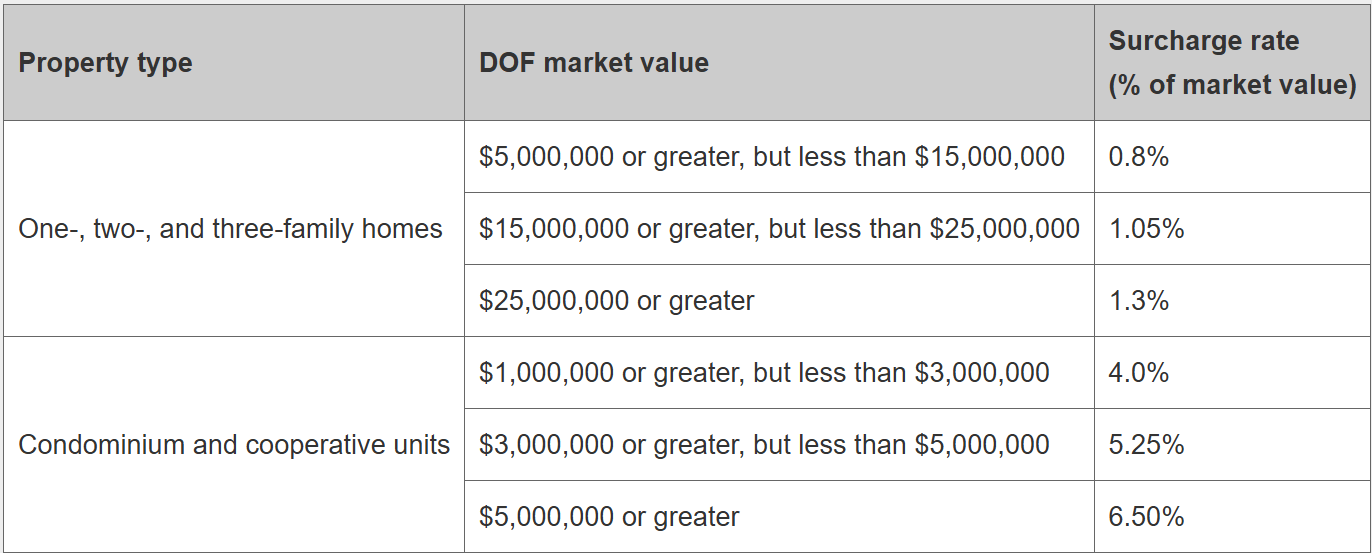
From a review of the property level tax bills, the DOF is phasing in the pied-a-terre surcharges for the first $50,000 above the initial thresholds for condos, co-ops and 1-3 family homes.
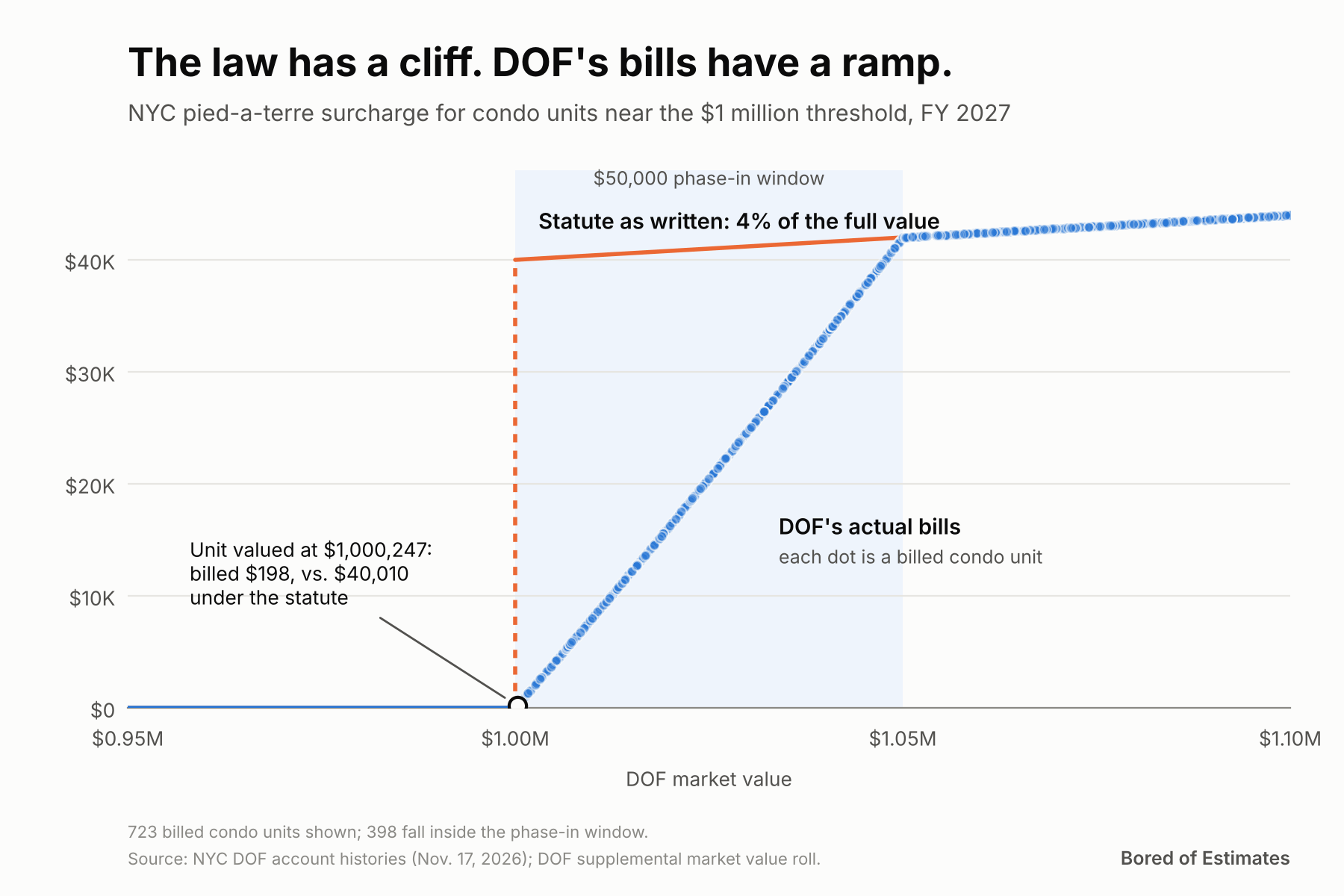
That means a house valued at exactly $5 million, or a condo at $1 million, currently faces no surcharge. Once the property reaches $5.05 million or $1.05 million respectively, its owner pays the full surcharge. This phase-in also likely applies at the $15 million and $3 million thresholds for houses and co-op / condo units, though I’m unable to verify treatment at the $25 million and $5 million thresholds.
As an example, this condo is valued at $1,000,247. A surcharge of 4% on the full value would be $40,009.88. Instead, the $197.64 charge reflects a linear phase-in. When the value is no more than $50,000 above the threshold, it is calculated as rate * value * (value - threshold) / $50,000. Applied to this property, that’s 4% * $1,000,247 * ($247) / $50,000 = $197.64, after rounding down.
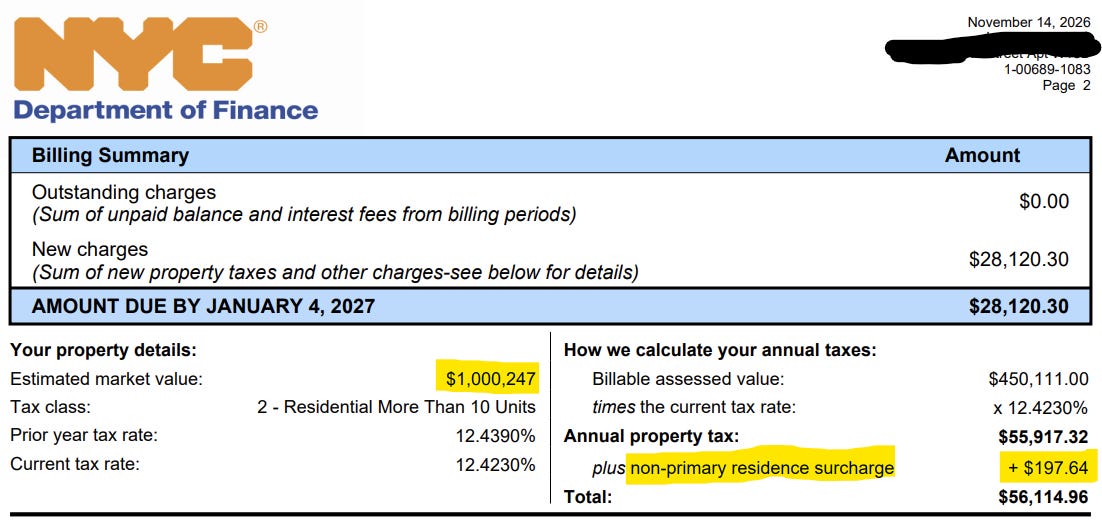
It’s the same for this condo:
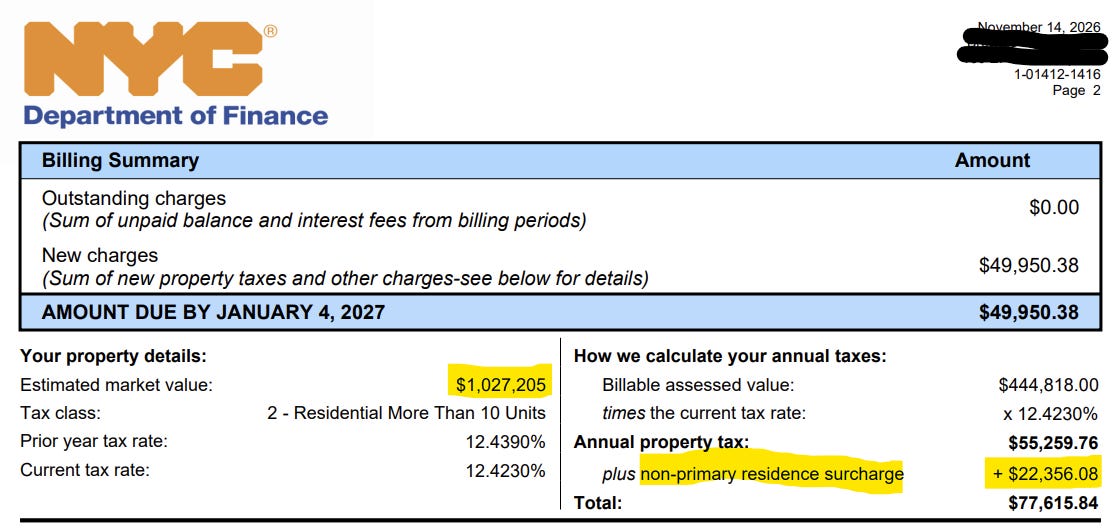
Applying the phase-in gives 4% * $1,027,205 * ($27,205) / $50,000 = $22,356.08 (again after rounding down). This is exactly what has been billed vs. the $41,088.20 without a phase-in.
And here’s an example of a house:
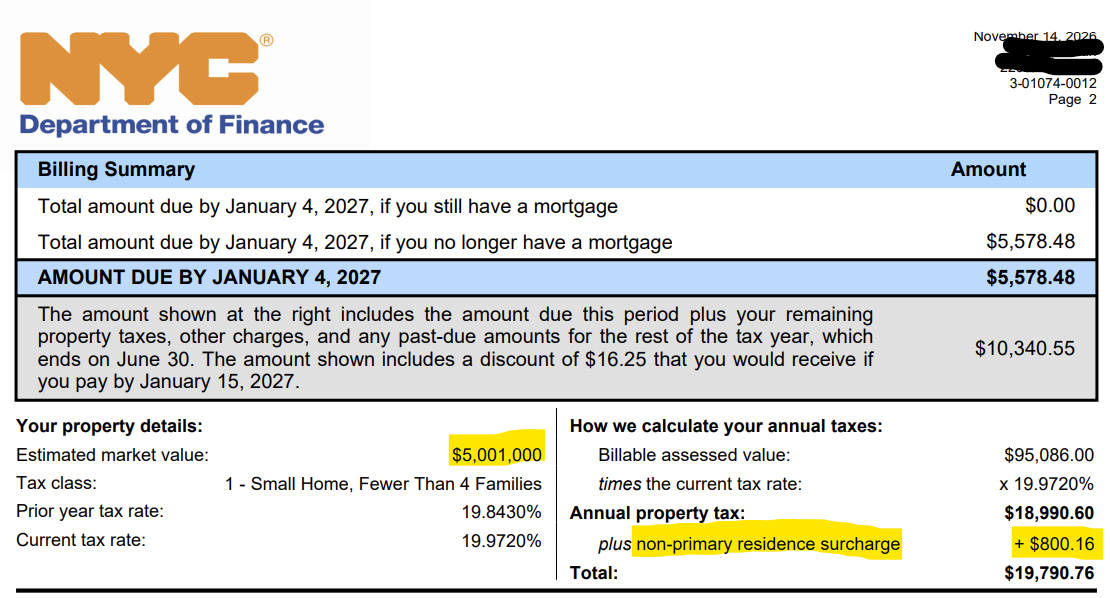
Applying the phase-in gives 0.8% * $5,001,000 * ($1,000) / $50,000 = $800.16, matching the bill and far below the $40,008 surcharge if there were no phase-in.
However, neither the statutes nor the rules mention a phase-in of the surcharge. See NY Tax Law § 1353; NYC Admin. Code § 11-3202; 19 RCNY § 62-06.

Odd as it may seem, the statutes and rules are written as cliffs where the tax increases from $0 to $40,000 when a house’s value increases from $4.999 to $5.000 million. By comparison, the State’s income tax benefit recapture also phases in, and that phase-in is expressly stated in the statute. NY Tax Law § 601(d-1).
The phase-in only affects about 500 properties, reducing billings by a little over $10 million. None of their owners are likely to be upset at a lower tax bill. But this isn’t exactly how it’s supposed to work.
Litigation Updates
There have been three lawsuits related to the pied-a-terre tax: one procedural, which I wrote about previously here, and two overlapping constitutional challenges.
Procedural Suit
The Richmond County Supreme Court initially sided with the homeowners in this lawsuit. It ordered the City to take down the supplemental roll, invalidate the initial notices based on that roll, and redo them with individualized determinations.
But the City promptly appealed to the Appellate Division, 2nd Dept., which reversed the lower court’s order and dismissed the case for lack of standing. In short, the appeals court did not recognize any injury claimed by the plaintiffs, either as a matter of law or due to insufficient evidence. I haven’t found a record of the plaintiffs seeking leave to appeal this to the Court of Appeals, NY’s highest court.
Constitutional Suits
I may write more about this later, but in broad terms two different groups of plaintiffs have filed suit in Suffolk County to declare the State law authorizing the pied-a-terre tax unconstitutional on its face. These do not challenge NYC’s implementation of the tax, but rather the State law itself.
The lawsuit against NYC’s implementation, even if it had succeeded, would only have delayed the tax. These lawsuits have the potential to nullify it completely, regardless of how NYC implements it.
Hi Tom, are you suggesting that the owners within $50,000 of the threshold levels will only be charged those de minimus amounts? Or does 'phase-in" mean that the full surcharge amount will eventually be captured, but it is just phased in over time?