

There’s been a lot of discussion on twitter, much of it wrong, about the supplemental market value roll that the NYC Department of Finance released Friday. Ostensibly it is a list of properties potentially subject to the annual non-primary residence property surcharge, aka the “pied-a-terre tax.” It is both more and less than that.
What It Is
Two .csvs with 959,710 rows, excluding headers
Every residential house, condo unit and coop building, other than those classified as rental buildings
24,000 of which are houses, condo and coop units over the value thresholds
A subset of coop units in coop buildings that have one or more units potentially in scope. DOF has never before published coop unit valuations
Required by law. Kind of1
What It Is Not
Only homes over $5mln and only coops/condo units over $1mln
The list of properties DOF is asking for proof of residency from
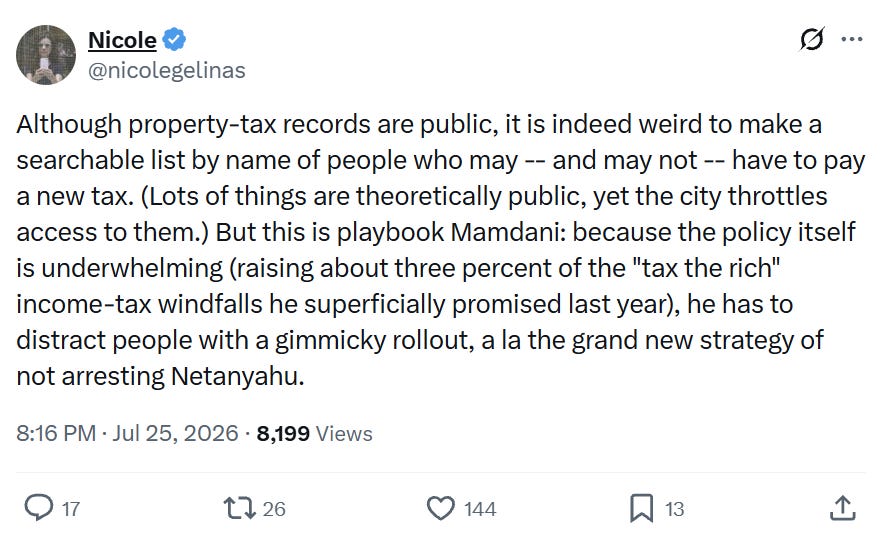
Doxxing, or any new ownership info that wasn’t already on the same website
Filtered for anything other than building classification code
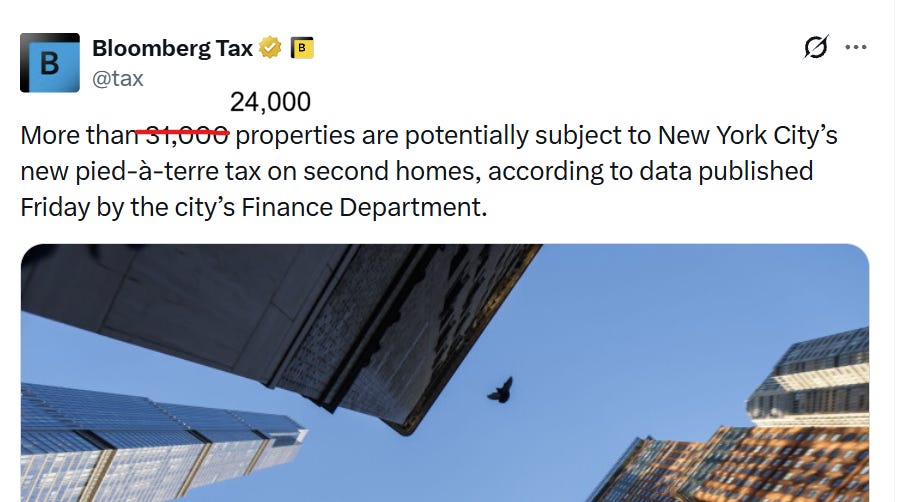
31,000+ properties potentially subject to the tax. That requires including 7,200 coop buildings over $1mln in the file
Prior Data
Backing up, the NYC DOF has provided property tax rolls for years via flat files, a map, a web portal and an API.
This data includes every individually taxed property in the city, along with its owner and assessment. (Coops are taxed at the building level, so unit level coop data is not included in this data). This has been readily accessible by anyone and everyone for years.
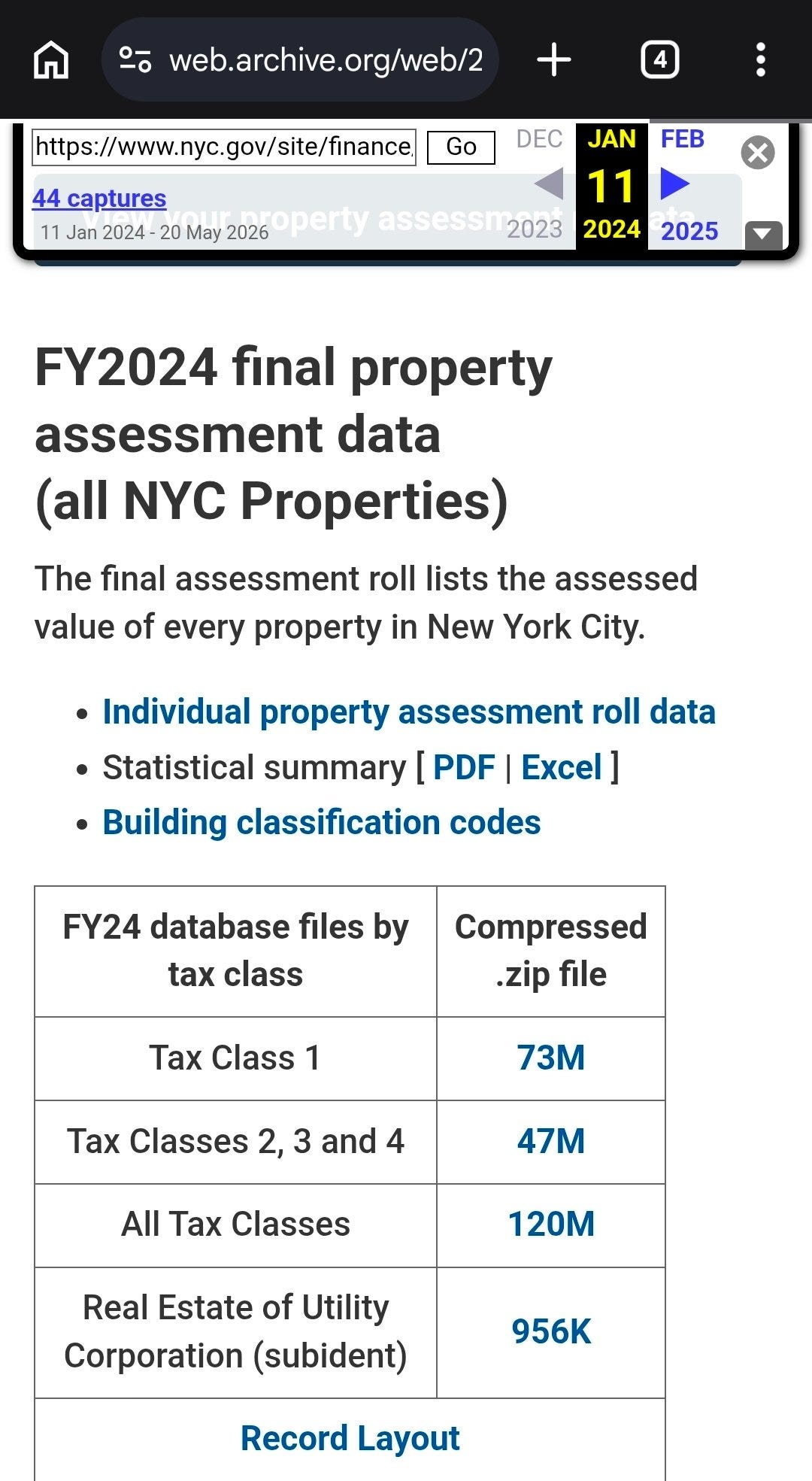
This is the same data I’ve used in prior analyses of NYC property taxes
New Data
On July 24th, the DOF posted a new supplemental market value roll to their assessment page. Both are .csvs that I recommend opening yourself to get a feel for the data.
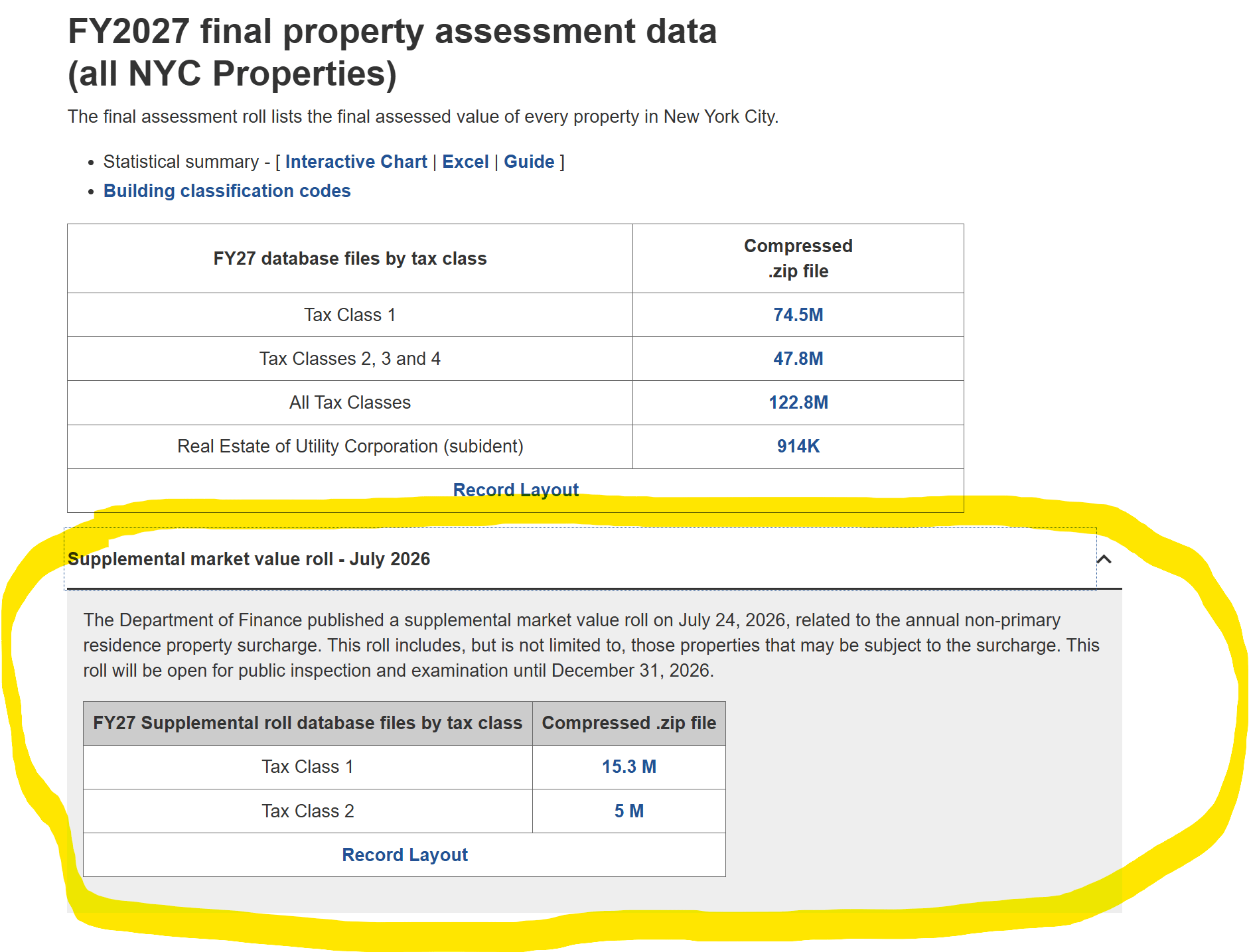
The files above it, which have been around for ages, list all the same properties and owners, albeit with many more columns for things like square footage, height, tax exemptions, etc…
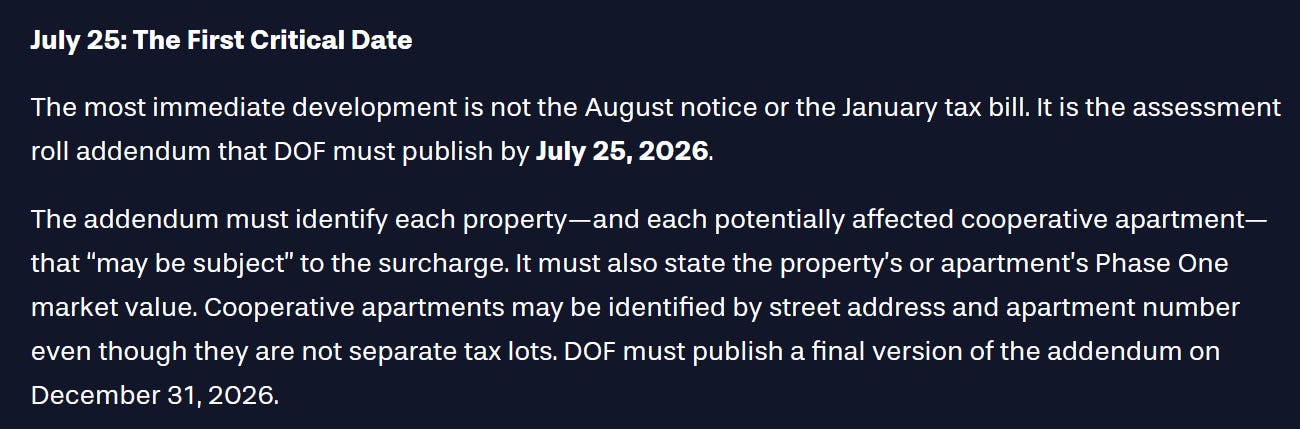
The City was required to publish this by July 25th to give notice to potentially affected property owners, as described here by Rosenberg & Estis2
The Tax Class 1 file is every class 1 property (1-3 family homes) that falls into one of the non-rental residential buildings codes. That includes A0-A7, A9, B1-B3, B9, C0, R3, R6, S0-S2. It excludes vacant land, garages, small rentals, and some other oddball categories.
Most of the 684,619 rows have values well under the $5 million threshold for the pied-a-terre tax. Only 6,800 exceed it.
The Tax Class 2 file is every condo unit and coop building, again falling under a non-rental residential building code including C6, C8, CC, D0, D4, DC, R1, R2, R4, and R9. Note that coop buildings are included, but the buildings themselves don’t really matter for the tax.
The Class 2 file also includes imputed unit valuations for 36,700 individual coop units, almost all in Manhattan. This is brand new, never released publicly before as far as I can tell.3
In total, there are roughly 12,000 condo units and 5,500 coop units above the $1 million threshold for the tax. There are also 7,200 co-op buildings that are over the threshold, but those can be ignored.
Added to the 6,800 class 1 properties, that gets you to a little over 24,000 properties. The only way to get to 31,000 is to include full coop buildings valued over $1 million, which is wrong.
Apparently, the DOF has private unit-level share data for coop units, which they then use to calculate a value for the units. It’s just the value of the coop * % owned by the unit. Further background from the Comptroller report on potential tax revenues

This is easy to check since the unit values for a given coop will add up to the total value for the coop

Why only 36,700 co-op units out of the nearly 500,000 in the City?
Hard to say with certainty, but given the sample and the valuations of them it seems to be only units in buildings that are within a factor of 2 of being in scope for the tax.
I.e. if a building is assessed at $10 million market value but the largest unit is only assessed at $200k, none of that building’s units will be included. But if a building has at least one unit valued at ~$500k+, then every unit in that building is included in the file. It doesn’t exactly map this way, but it’s the best explanation for why ~90% of buildings, representing ~450k coop units, are not included
So How Many Properties are in Scope?
The upper limit from this file is a little over 24,000. That is every home, condo and coop unit valued over $5 million or $1 million respectively. But a large fraction of those units will be someone’s primary residence, whether that be the owner directly or via LLC, an immediate family member, or a long-term renter.
The original estimate of ~10,000 or so properties still seems reasonable, and much more so than the 31,000 number that was published by Bloomberg.
Edit: There is newer report from the Comptroller that I neglected (h/t Nick Garbar of NYS Focus). They did the fiddly work of filtering out properties that recieved a tax exemption requiring owner-occupancy and got down to 13,586
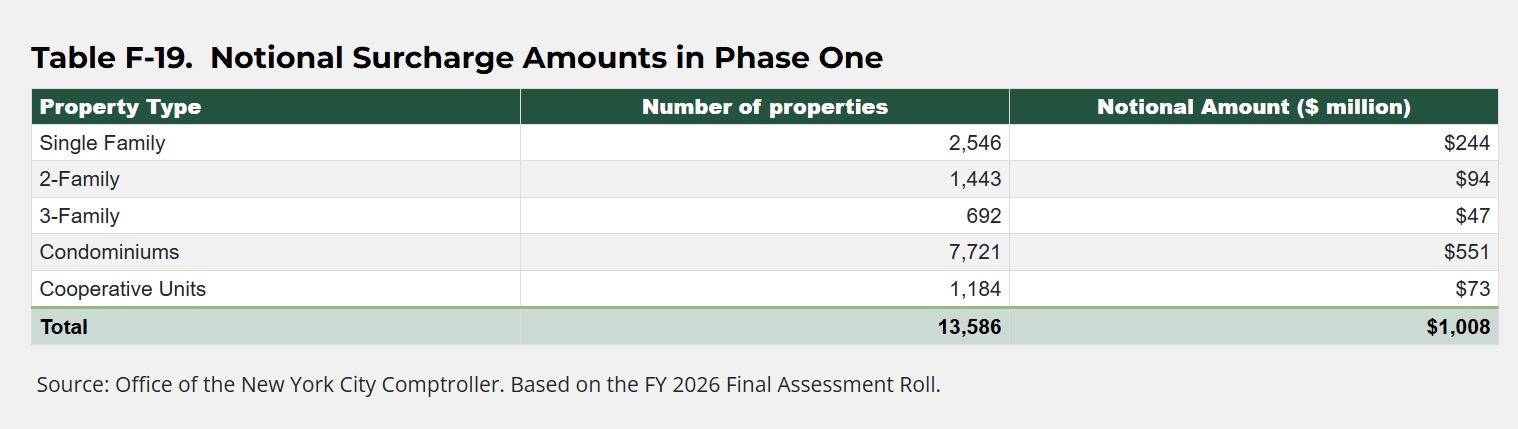
This still leaves in properties used as the primary residence of someone other than the owner, including family members and long-term lessees, that are exempt from the pied-a-terre. As well as owners who were otherwise ineligible for one of those exemptions, e.g. by being over the income limit for STAR or recieving that as a credit. Expect the final number to come in lower still, though how much lower is anyone’s guess.
Is the Pied-a-Terre Tax Good?
I’ll stick to the easier questions. The most I’ll say is that it’s complicated
Specifically the Rules of the City of New York Title 19, §62-07(b): “the department shall publish an addendum to such assessment roll.” The wrinkle is this rule was proposed and adopted by the Deptartment of Finance; they could have left it out of the rule they are now bound to follow. If they had, the standard would be ‘make available for public inspection’ rather than ‘shall publish.’ None of the commenters on the rule took issue with this at the time
Rosenberg & Estis is also notable for their role in the Tax Equity Now NY litigation to compel reform of the NYC property tax system - https://boredofestimates.com/p/the-city-wants-to-settle-a-major
You can distinguish condos from coop buildings and coop units by looking at rows with a COOP_NUM, meaning it’s a coop, and RECTYPE = ‘U’, meaning it’s a unit. RECTYPE 1 coop rows are for the entire building, or the coop portion of the handful of condop buildings